
Looking for media literacy education? You’ve landed in the right place.
Take the Environmental Printing Quiz
http://www.zoomerang.com/Survey/?p=WEB229WPZEZVB7
http://www.zoomerang.com/Survey/?p=WEB229WV624ZTN
Cindy Pulley
Media Literacy Education in the Digital Age
13 July 2010
Media Influence
Part 1
This lesson is the first of Young Voices for Good Choices, a cross-curricular service-learning course designed to introduce K-12 teachers to teaching and immersing students in activities that promote civic engagement, wise choices and healthy communities.
To give you a brief primer of this lesson, click on the link for a Power Point presentation below:
Objective:
- Teachers will experience and observe how media often functions as a super peer in setting agendas and “branding” experiences for the general population and, specifically, teens.
- Teachers will learn how to present media influence using age-appropriate examples that can be deconstructed by students in their classrooms. The purpose is to provide tools for discernment about the media youth may be exposed to.
Delivery: This lesson is intended to be presented online, asynchronously
Two activities follow: The first is to illustrate how the symbols we see in our consumer society provide meaning and actually have persuasive influence on what we buy, what we do, and what we eat. The first is to take a survey identifying the companies or products represented by the logos, and then collaborating with the other members of the class about the impact of commercial symbols in our lives. The second is identifying the way products are placed in programs and how, in this case, the vehicle of the message may influence behavior to buy a product or engage in a behavior. A follow up in this activity is to answer the questions based on the domains and core principles of media literacy as teachers. This will give them practice in presenting the same activity to their students.
Please take the two quizzes below:
http://www.zoomerang.com/Survey/?p=WEB229WPZEZVB7
http://www.zoomerang.com/Survey/?p=WEB229WV624ZTN
(Reviewers: To help you see the whole picture, the individual logos featured in the two quizzes are in the panels below.)
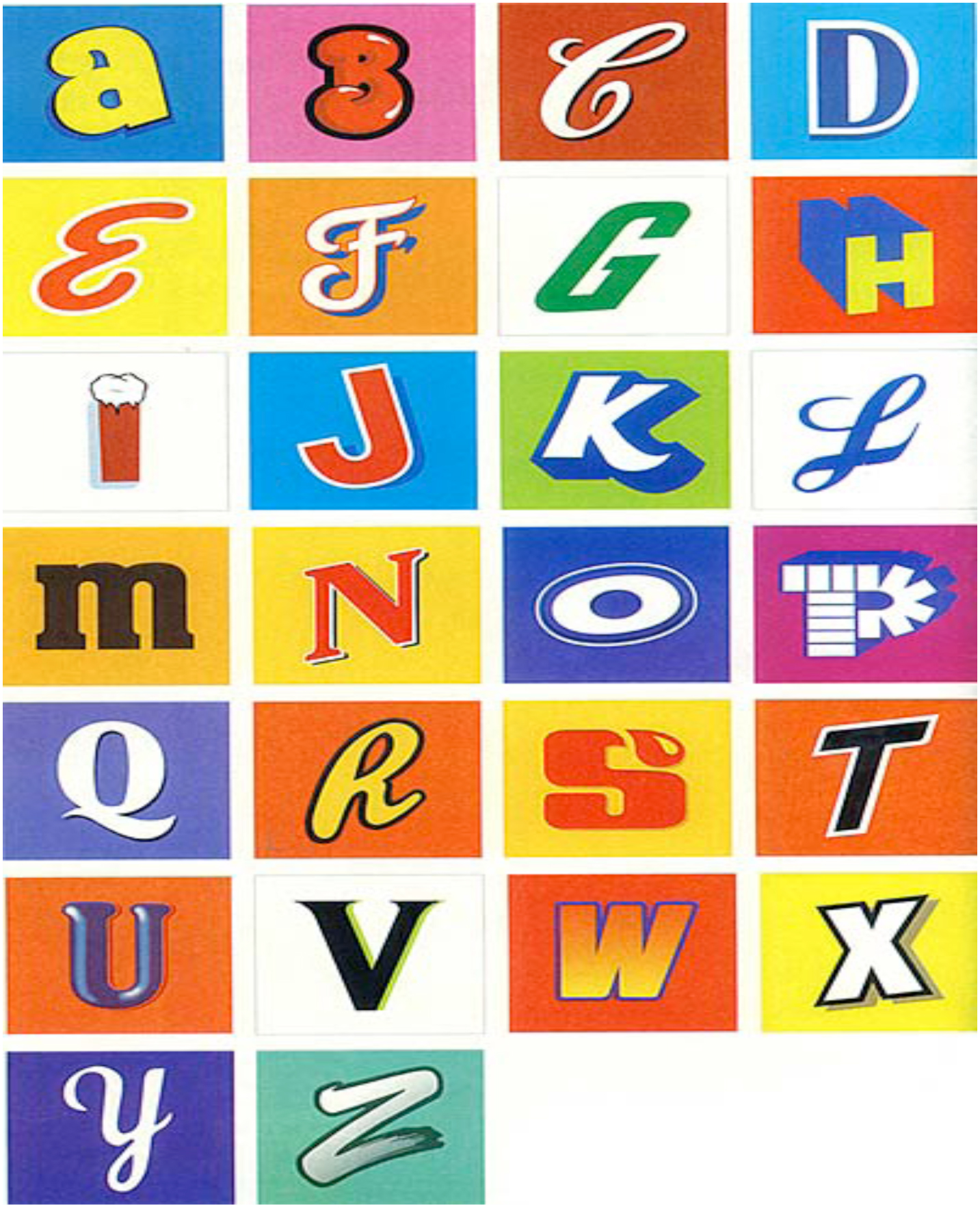
A: ALL, B: BUBBLICIOUS, C: CAMPBELLS, D: DAWN, E: EGGO, F: FRITOS, G: GATORADE, H: HEBREW NATIONAL, I: ICE, J: JELLO (SUGAR FREE), K: KOOLAID, L: LYSOL, M: M & M’S, N: NILLA WAFERS, O: OREO, P: PEZ, Q: Q-TIPS, R: REESE’S, S: STARBURST, T: TIDE, U: UNCLE BEN’S, V: V8, W: WISK, X: XTRA LAUNDRY DETERGENT, Y: YORK PEPPERMINT PATTIES, Z: ZEST
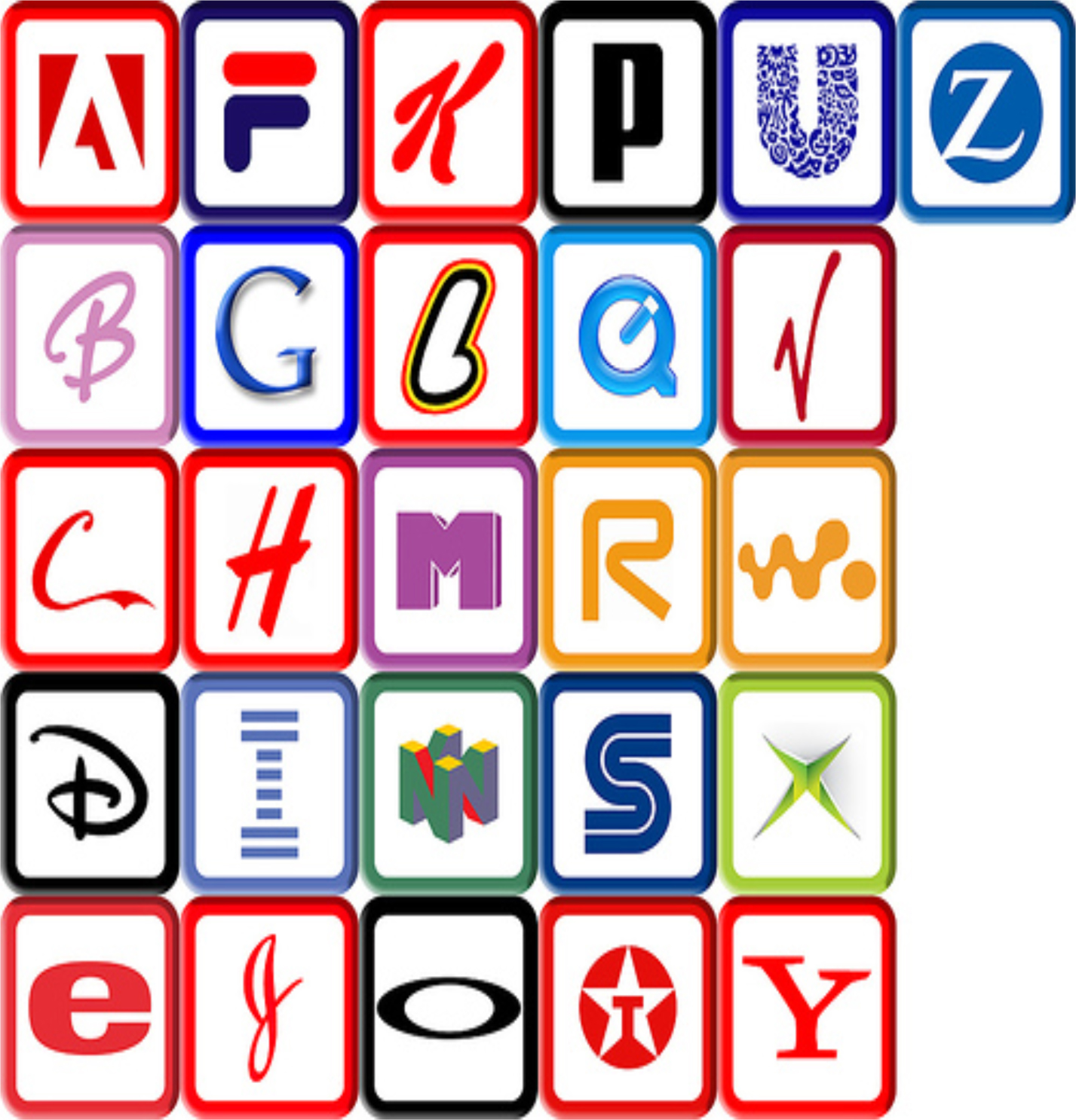
Adobe, Barbie, Coca-Cola, Disney, eBay, Fila, Google, H&M, IBM, Johnson’s, Kellogg, Lego, MTV, Nintendo, O and Company (need to verify) ,Puma, Quicktime, RAC (need to replace), Sega, Texaco, Unilever, Virgin, Walkman (Sony), Xbox, Yahoo, Zurich (insurance company)
Activity 1 (For teachers): Look at the results of the survey on the link. On the blog, please indicate those logos that were easiest to define for each quiz and tell us why. Which ones were more difficult? Did any of them fall in a certain category, i.e:
- Food related– fast food or store product?
- Business?
- Media related?
(Link to results will be posted after the quiz is taken).
Activity 2: Send the link to your students. Ask them to reflect on their answers. Share your answers with them. How did your answers differ from theirs?
The above model represents an integration of two theoretical frameworks (Bazalgette C.,1992; Thoman, E., 2003).
Part 2
The above chart is a resource to guide you through the next part of this lesson. We will be using the subject of tobacco use to see how every day persuasion influences people according to their perspective or role they play in society. There are three activities related to this module. For all three you will need to click on the link above to view five movie clips depicting product placement in movies that were well attended by young people. Note as you are watching that this fact from the Campaign for Tobacco Free Kids: “The tobacco industry spends more than $12.4 billion per year – over $34.1 million a day – marketing its deadly products in the U.S. alone, much of this reaching kids. At this rate, the companies have spent $24,115,009,329 so far this year.”
Resources:
Some resources that may help you include:
http://tobaccofreekids.org/adgallery/. This is just one fact. Take a look at the following reliable websites to find other facts about the impact of companies selling their products to young people.
http://legacy.library.ucsf.edu/popular_documents/popular_documents_movies.jsp
http://www.ncbi.nlm.nih.gov/pmc/articles/PMC1766059/pdf/v011p00i81.pdf
http://www.dhss.mo.gov/SmokingAndTobacco/
The clips were taken from:
- Superman, the movie
- The Net
- Men in Black
- Hackers
- Forest Gump
Go back to our introductory lesson where you posted a picture and a biography of yourself. Assuming that we have nine people in this class, please place yourself in the following assigned Wiki Groups. Divide the total number of people in class by three and count down three in order that the picture and bio appears. If there are nine people the first three will be group one, the next three in group two, and the final three in group three. Wiki Groups will participate in an online discussion on the their group’s assigned Wiki. Note the chart below this section. study the core concept and the questions related to each. Each group will address the questions in the section with each of the video clips in mind? Note: Some of the questions will be more suitable to the videos viewed than others. Answer those that are most relevant.
1) Audience and authorship (first group)
2) Messages and meanings (second group)
3) Representation and reality (third group)
| AUDIENCE &AUTHORSHIP | 1. Authorship |
|
| 2. Audience |
|
|
| MESSAGES &MEANINGS | 1. Values and points of view | • What values did you notice:o Beauty?o Confidence?
• How might different people understand this message differently? |
| 2. Interpretations | How might different peopleunderstand this message differently?• What is my interpretation of this? | |
| 3. Effects on attitudes and behaviors | • What do I learn about myself frommy reaction or interpretation?• Will this message influence my
attitudes, opinions or actions? |
|
| 4. Multiple production techniques | • What techniques were used?• Lighting?• Music? | |
| REPRESENTATION AND REALITY | 1. Messages filter reality | • Is this fact, opinion, or somethingelse?• How credible is this (and what
makes you think that)? • What are the sources of the information, ideas, or assertions? |
| 2. Messages omit information | • What information is left out?• What were the sources for theinformation? |
The above model represents an integration of two theoretical frameworks (Bazalgette C.,1992; Thoman, E., 2003). Questions were adapted from the National Association for Media Literacy Core Principles.
Part 3: Critical Analysis (Optional)
Read Joyce Wolburg’s paper on the boomerang effects of media. Make an entry on the Wiki as to how would this apply to the students in your classrooms.
The rationale behind this course is to help teachers gain confidence in using media to address the problems it creates in the health and choices of youth. It also empowers them with skills to construct effective media messages and then pass that grounded knowledge to students who may or may not have more technical skills than they do.
 platinum3
Pingback: Unit 2: Media Literacy | Be A Different Breed
Hey Kelsie:
Thanks for linking to my site. I read your entry referenced in this link, and I appreciate your insights.
CP